Showing posts with label interior design. Show all posts

Thursday, April 20, 2017

Spotlight on Cabinetry Design - Favorite Styles

Cabinetry Styles

The character of the kitchen is displayed through the cabinetry design. With a wide selection of panel styles plus combinations of colors and textures, the custom home owner has free rein to complement their home style! 
Below are our Kurk homeowners' favorite styles of cabinetry, including door panel design, overall color schemes, selection of wood, or the cabinetry layout itself:

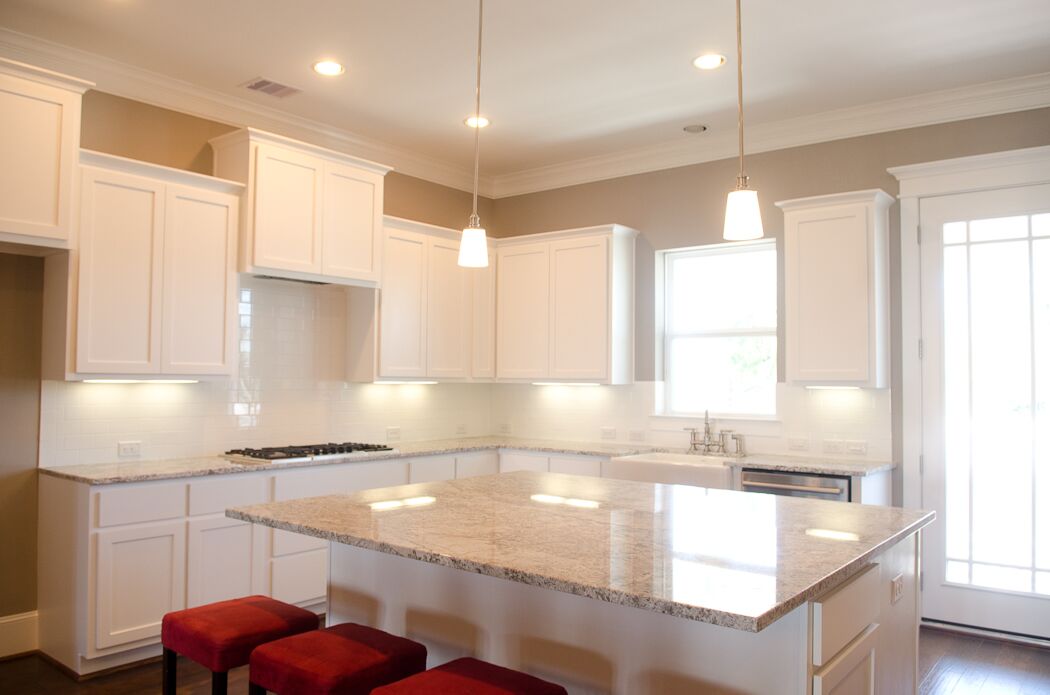
Shaker Doors

Frequently seen in contemporary homes, the simple, clean aspect of shaker doors complement many home styles, including farmhouse and craftsman. The focal point of the kitchen becomes the backsplash or granite, instead of the cabinet doors themselves. Perhaps most often viewed as white cabinetry, shaker doors come in a variety of stain and paint colors. Typical wood species include poplar and maple. 

Ornate Doors and Cabinetry

The warm yet elegant feel of a French Country kitchen is accented by the cathedral arched panels and decorative crown and trim surrounding the cabinetry. The detailed scrollwork and corbels throughout the set of cabinetry details this particular home style - most often seen in soft hues of cream, beige, soft green and natural wood to mimic a provincial feel. For a cleaner look, homeowners typically select maple or poplar wood species, but oak and alder woods have given a more rustic charm to the doors as well.


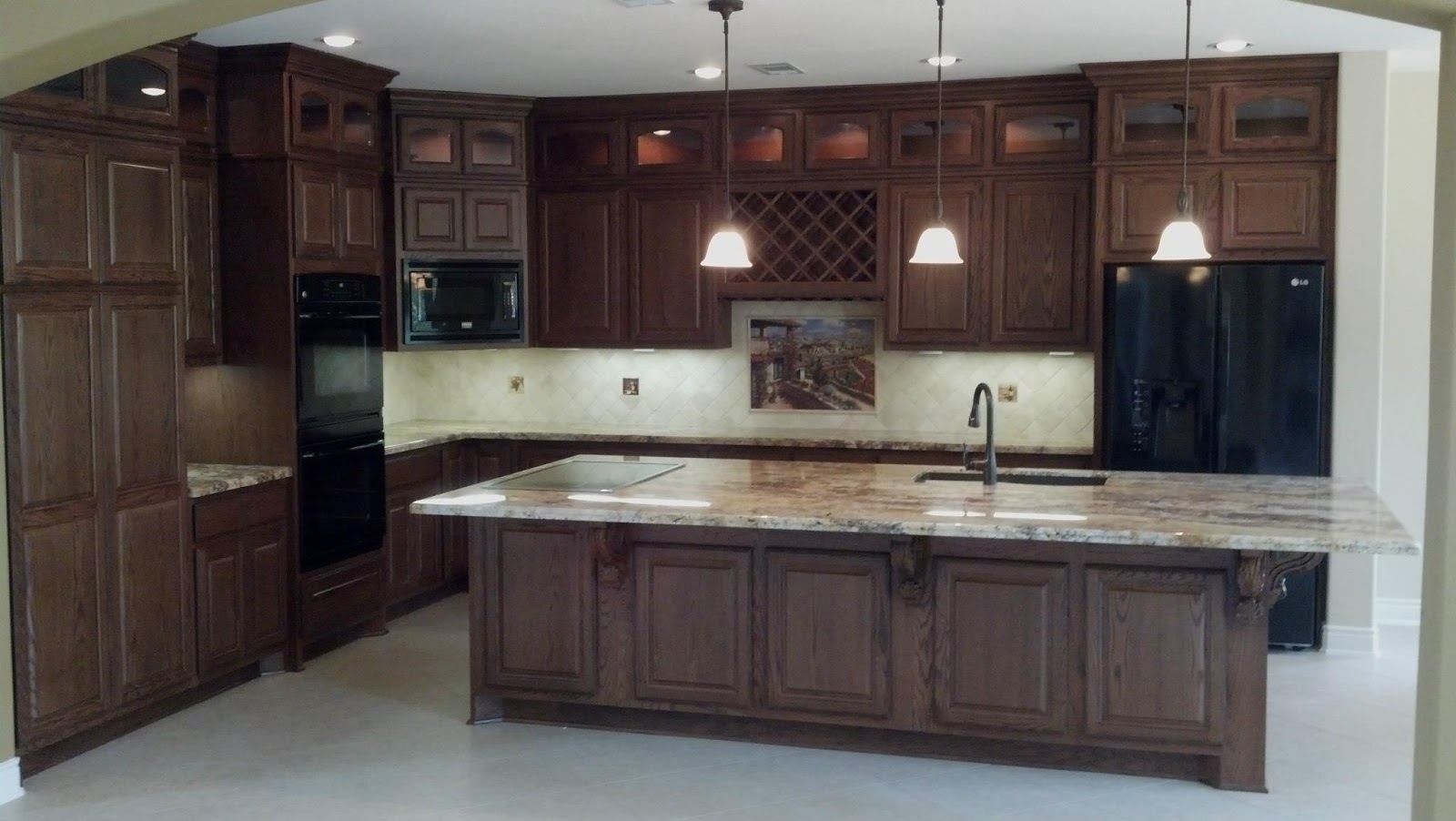
Raised Panel - Traditional and Rustic

Slightly more decorative than the shaker style, the traditional raised panel door style shifts the focus of the kitchen on to other elements, such as the stone arch and backsplash as the first picture below. Two-tone cabinetry is a frequent occurrence, as well as a plethora of paint and stain selections. The raised panel doors for traditional styles are most often maple or poplar wood, while rustic styles showcase alder or oak for more texture. 

Traditional:

Rustic


Bead Board

For a farmhouse or cottage style of kitchen, bead board door panels add a lovely element of design and texture. Bead board is great as an accent piece as well; it can be used as an island end panel (or "kicker") as well as a backsplash piece. Commonly painted white in maple wood, beadboard can be painted or stained in any color.

Glass Cabinetry

Frequently used in kitchens to highlight specialty china or glassware, glass cabinet panels create a visually larger space. Butler pantry cabinets and top cabinets are commonly inlaid with glass panels. The interior of the cabinet can be bead board or a solid panel, painted or stained to match the exterior. Glass panels are typically bordered in maple, oak, or alder wood.

Cabinetry Toppers

The addition of cabinetry above the upper cabinets to normal cabinetry extends the eye all the way to the ceiling, enlarging the kitchen itself. Over a sink or a refrigerator, these are referred to as "bridge cabinets" - and can match the style of the cabinet, or consist of glass with or without lighting. Plus you get the added benefit of not needing to clean on top of your cabinetry! 


Choosing your own adventure, one selection at a time! What would you choose?


Contact us today to view our design showroom and lovely selection of cabinetry options.
* www.KurkHomes.com * 1-800-749-KURK *


© Melanie McGinley Sparks and Kurk Homes, 2017. Unauthorized use and/or duplication of this material without express and written permission from this site’s author and/or owner is strictly prohibited. Excerpts and links may be used, provided that full and clear credit is given to Kurk Homes and Melanie McGinley Sparks with appropriate and specific direction to the original content.

SaveSave

Tuesday, February 21, 2017

From Quarries to Custom Homes - All About Countertops!

Kitchen and bathroom designs can largely rely on the selection of the countertop. Whether your design is contemporary, farmhouse, French country, or Texas rustic - the surface you select for your countertop can either add complexity or simplicity - easing the eye into fun backsplash designs or funky cabinetry. Or, it can all blend like a beautiful ethereal piece of art.

Here are a few options of countertops - split into the natural "rock" formations from quarries and engineered products from manufacturers.

Natural Products: 

Granite

Probably the most well-known countertop surface in homebuilding is granite. Known for its durability and plethora of color selections from white to black and every variation in between, granite is a favorite among customers and builders alike. Although granites are sturdy rocks of countertops, they do require maintenance by sealing the surface as needed. Lighter granites will need more frequent  sealing applications - closer to six months - while darker granites can last a year or longer without re-sealing.

Granite is a natural product, pulled from quarries around the world. Sandstone, that has been melted by the earth's heated core and then cooled, create this multi-dimensional rock; the difference in colors attributed to the minerals (such as iron creating a more red tint) that were trapped during the melting and cooling process. 


Colonial White Granite
Gorgeous slab of Green Labradorite Granite

Marble

One of the oldest known countertop surfaces is marble. Created from massive heat and pressure on limestone over thousands of years, marble has been used to create entire spectacular cities most notably in Greece, Italy, and surrounding countries.

The historic prestige of marble is a draw for many customers and builders, however, the softness of the stone is a drawback. Marble is more porous than granite or manufactured stone, therefore, it can stain and scratch without the utmost care. For that reason, marble countertops are not as popular in kitchens, but still have a frequent occurrence in guest or powder bathrooms. Re-sealing marble is recommended as needed for high traffic areas as much as every few months.

Carrara Marble Vanity Top

Butcher Block

Many people are drawn to the rustic wood look and feel of an authentic butcher block countertop. Whether as a dedicated portion of the island, or using the entire space as a giant cutting board, butcher blocks add texture and warmth to any kitchen. 

Maintenance needs of butcher blocks include sealing and coating with mineral oil, typically every few months. Scratches from knife blades are to be expected, and placing hot pots directly onto the surface should be avoided. It is wood after all!

Beautiful Butcher Block Island

Quartzite

Quartzite is very similar to granite in its creation - differing only in the abundance of quartz in the sandstone. Many people confuse engineered quartz countertops with quartzite, and the distinction should be made that quartzite is a naturally occurring product, while quartz countertops are man-made. See further on for the description of Silestone and Ceasarstone quartz countertops. 

As a natural product, quartzite - not unlike granite - can vary in its character. In the pictures below, the quartzite is the "Super White" selection. However, depending on when the product was harvested from the quarries, as well as the location of the quarries themselves, the color and veining patterns can vary immensely! Although harder than granite, quartzite still needs maintenance of re-sealing every one to two years. 

Lovely Island and Perimeter of Super White Quartzite


Super White Quartzite Island and Perimeter


Engineered Products: 

Quartz Countertops - Ceasarstone and Silestone

Made of a composite of mostly natural quartz with resins, Ceasarstone and Silestone are the least porous man-made countertops of this list with durability that exceeds marble, granite, and quartzite.  The difference between the brands is that Ceasarstone is comprised of over 93% quartz, while Silestone is at 90%. Silestone has more color selection while Ceasarstone has broader options for finishing on edges. 

Both products are consistently patterned throughout, there will not be color variation amidst a slab of manufactured quartz as there would be in granite, marble, or quartzite. For this reason, the selection process can be a simple one - the swatch will match the slab. Also convenient for the homeowner, quartz countertops do not need to be sealed.

Ceasarstone Display at our Kurk Homes Design Center
Blanco Orion Silestone
Silestone "White Platinum" 

Cultured Marble

Cultured marble countertops are made from marble particles mixed with liquid polyester resin. Any shape can be custom made, since the product is molded. Typically coated with clear finish in either high gloss or matte, cultured marble countertops are most popular in bathrooms with recessed sinks. The color selection is endless, as the manufacturer can also tint the product to suit the customers' needs.

With the resin, the cultured marble is a non-porous product that is harder than marble, yet softer than granite. Re-finishing is recommended to prevent resistance to stains and scratches, however, unlike the natural materials, cultured marble can have scratches or abrasions filled relatively easily with a gel compound. 

Platinum Cultured Marble Vanity Top


Solid Surface:

Similar to cultured marble, solid surface countertops are moldable - made of a polyester resin with bauxite filler and pigments. They are stain-resistant and durable in comparison to products that have a seam, thus, they are highly used in the medical field, but residential use is also common. 

The countertops are created to mimic other surfaces, such as wood, stone, quartz, granite, or marble - so the color and pattern selection is endless. Some homeowners prefer the variety of the selections and the cost effectiveness of the solid surface countertop compared to granite or marble.

Corian Linen Countertop


Which ones would you choose for your home? 

As always, if you would like to learn more about Kurk Homes and what we can offer our customers, please visit our website at www.KurkHomes.com or call us at 1-800-749-KURK. Thanks for stopping by! 


© Melanie McGinley Sparks and Kurk Homes, 2017. Unauthorized use and/or duplication of this material without express and written permission from this site’s author and/or owner is strictly prohibited. Excerpts and links may be used, provided that full and clear credit is given to Kurk Homes and Melanie McGinley Sparks with appropriate and specific direction to the original content.

SaveSaveSaveSave

Wednesday, October 19, 2016

Above and Beyond! A Dozen Design Ideas for Your Ceiling

All about Ceiling Design! 


Not only is a raised ceiling fantastic for making the room feel and look larger, it can add character and interest in the way that it is raised. Check out our custom designed favorites and differentiating characteristics! 


Groin Vault 

This four sided vault is also called a Cross Vault. The rounded sides join at a lowered point in the middle - what can also be pictured as two barrel vaults intersecting. 


Barrel Vault

As the name describes, a barrel vault is a fully rounded portion of the ceiling - half cylindrical in appearance. Much wider than an "arch" a barrel vault can typically be seen in intricately designed foyers or bathrooms. 


Cathedral Vault

Raised to a top point or ridge beam, a cathedral vault is the highest ceiling design possible. These ceilings have to be specially engineered for wide spans, and can give the illusion that even a small room is quite spacious.


Flat Top Vault

A variation of the cathedral vault, above, this type of vaulted ceiling has a top portion (custom designed in width) that spans across the vault with a joist system in lieu of a ridge beam. 

Shed or Half Vault (one sided slope)

If there is a living area or a need for mechanicals above a portion of the room, a shed or half vault can maximize the height of one side of the room. This type of vault is commonly seen in contemporary plans, but can be used in any style of home to increase the perceived size of the area. 

Domed Ceiling

A fully circular "pop-up" or raised portion of the ceiling is called a dome. Most commonly seen over spiral or rounded staircases, this ceiling design can also highlight the ceiling of a foyer or above a large jacuzzi tub. 


Tray and Double Tray (or Step) Ceiling

Popular in master bedroom suites and family rooms, a tray ceiling is a great way to add vertical height to the room without sacrificing living area or attic space above. Adding rope lighting and crown molding in the double tray, as shown below, is a wonderful way to highlight this architectural feature. 


Sheetrock Design

A sheetrock design can be created in a formal living or dining space by "furring down" the outer edges of the ceiling, giving the illusion of a raised ceiling. Similar to a tray ceiling, a sheetrock design does not take a full foot of lumber, but a sheet of plywood or OSB cut to design and applied to the ceiling. 

Coffered Ceiling

A coffered ceiling has several names throughout the industry: caisson, lacunar, and waffled all point out the same basic structure as pictured. The base height of the room and the decorative "beams" interlace in a grid or tic-tac-toe pattern that can be as deep as one foot, and as little as three inches. 


Beamed Ceiling - exposed or faux beams and/or trusses

Highlighted with exposed or faux beams and/or trusses, a beamed ceiling can add both a rustic or contemporary flair depending on the type and color of wood selection. Typically, a smooth pine painted or stained a dark color is for more modern or contemporary appeal while a rough cedar stained a natural color is frequented in rustic or farmhouse design.


Tin or Tiled Ceiling

Common in barrel ceilings, as shown, a decorative or metallic tile can add visual interest to a bathroom ceiling. Tin ceilings are a great feature in billiard or game rooms, either a raised portion as in a tray, or throughout the entire room.


Tongue & Groove Pine Ceiling

Frequented in the Texas Hill Country designs, a tongue and groove pine ceiling can bring the warmth of wood into both outdoor and indoor spaces. Commonly seen on large rear porches, the wood ceiling application can also add wonderful visual interest to large family rooms with cathedral vaults.


© Melanie McGinley Sparks and Kurk Homes, 2016. Unauthorized use and/or duplication of this material without express and written permission from this site’s author and/or owner is strictly prohibited. Excerpts and links may be used, provided that full and clear credit is given to Melanie McGinley Sparks and Kurk Homes with appropriate and specific direction to the original content.
SaveSave

Tuesday, September 20, 2016

Universal Design - Creating a Home for a Lifetime


It's not an easy subject to cover. No one ever wants to think about their parents, themselves, or future generations not being physically able to safely enter a bathtub or walk up a few porch steps. With Universal Design, however, that thought process is taken care of for you - with more items you may not have even thought about.

So, what is Universal Design? And who does it benefit? 


Universal Design is a way of strategizing a plan, or modifying a home, to maximize accessibility for any person that may have physical restrictions in the future. This means elderly individuals, as well as someone who may be short-term, physically injured.

Bathrooms are specifically targeted, as they are the primary source of injuries in the home for any age, with over an astonishing 80% of injuries. Listed below are some alterations to make during the design phase that could ensure your home could really be suitable for a lifetime.


SAFETY FEATURES


BATHROOMS:

  • Walk-in bathtub options
  • Sloped and recessed (no ledge or step) oversized showers
  • Additional hardware "grab bars" in showers and commode rooms

THROUGHOUT:

  • Additional lighting, especially in transitions between rooms and differing floor heights
  • Sloped or ramped porch entry in lieu of steps
  • Non-slick flooring on interior as well as sidewalks and patios

CONVENIENCE & COMFORT FEATURES 


BATHROOMS:

  • Handheld shower head & built-in shower seat
  • Comfort height commodes


THROUGHOUT:

  • Open concept living
  • 3'0 wide or larger doors, entries, and exterior walkways
  • Lowered countertops, outlets, and switches
  • Zoned HVAC, multiple thermostats
  • Lever hardware instead of round knobs


Here is an example of an open concept plan with comfort and safety features of Universal Design, designed by Kurk Homes. We originally created this plan with the idea of building a secondary structure on a property so that aging or physically challenged loved ones could have the security of being close by, but still maintain independent living. 


Chris McGinley, Kurk Homes President, was the chair of the 50+ housing council for Greater Houston Builders Association, focusing on universal design and "aging in place." He is also pictured above, with our grandparents and the co-founder of Kurk Homes, Mr. Chester Kurk, honored in our July post.


© Melanie McGinley Sparks and Kurk Homes, 2016. Unauthorized use and/or duplication of this material without express and written permission from this site’s author and/or owner is strictly prohibited. Excerpts and links may be used, provided that full and clear credit is given to Melanie McGinley Sparks and Kurk Homes with appropriate and specific direction to the original content.